
The Map of Emotions: Journey Toward Emotional Intelligence
Introduction
1. Why Learn the Language of Emotions?
2. How Symbols Speak to the Unconscious
3. Your Body Is the First Emotional Landscape
4.Creative Exercise : My Emotional Map
5. Why This Activity Works
Conclusion
Introduction
What if understanding our emotions felt less like solving a problem and more like setting off on a treasure hunt?
Whether you're five or fifty, emotions can sometimes seem confusing. Joy, anger, fear, sadness, excitement—they come and go like changing weather, often without warning. While we usually try to explain our feelings with words, emotions often speak another language: the language of images, symbols, colors, and imagination.
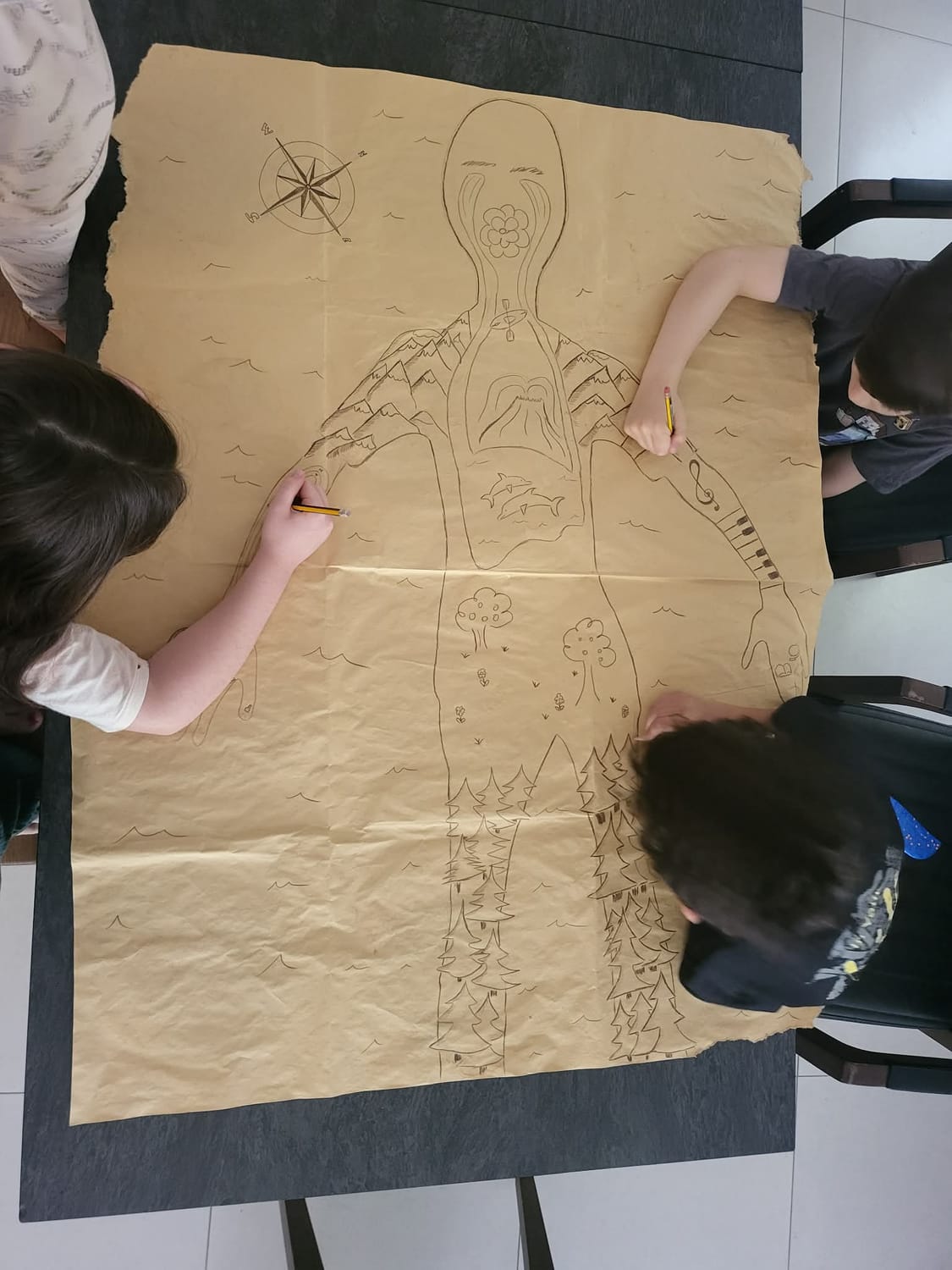
During the holidays, when families have a little more time to slow down and reconnect, creativity offers a wonderful opportunity to explore this inner world together. Instead of asking, "How are you feeling?", what if you asked, "What does your emotional landscape look like today?" Is it a peaceful meadow? A stormy sea? A towering mountain waiting to be climbed?
In this article, you'll discover how creating an Emotion Map can help both children and adults develop emotional intelligence through art and play. Inspired by explorer maps and treasure hunts, this simple activity transforms emotions into landscapes, making them easier to recognize, express, and understand.
You don't need to be an artist—only curious. Every mountain, river, forest, or hidden treasure you draw becomes a symbol of your inner world. As you create your map, you'll begin to see that every emotion has a place, every challenge hides a lesson, and every explorer carries valuable treasures within.
So, gather a large sheet of paper, a handful of colored markers, and your sense of adventure. It's time to discover the incredible landscape that already exists inside you.
1. Why Learn the Language of Emotions?
Emotions are not problems to solve or feelings to hide—they are valuable signals that tell us something about our inner world. Joy reminds us of what nourishes us, fear helps protect us, anger points to unmet needs or crossed boundaries, and sadness encourages us to slow down and heal. Developing emotional intelligence begins with a simple yet powerful skill: learning to recognize, welcome, and name what we are feeling.
For children, this can be challenging because they often experience emotions long before they have the vocabulary to describe them. Instead of saying, "I'm anxious," a child may draw a dark cloud, a volcano, or a stormy sea. Images become their first emotional language. Adults are no different. Even with a rich vocabulary, there are moments when words seem too small or too confusing to capture what is happening inside us.
This is why symbolic expression is so powerful. A symbol allows emotions to be seen rather than explained. A winding river, a steep mountain, or a hidden cave can reveal feelings that are difficult to put into words. By giving our emotions a shape, a place, and a story, we begin to understand them with greater compassion and curiosity. Sometimes, when words are not enough, symbols become the bridge between our conscious mind and the deeper wisdom of our inner world.
2. How Symbols Speak to the Unconscious
Our unconscious mind doesn't communicate in sentences—it speaks through symbols, images, dreams, metaphors, and stories. This is why we often dream in vivid scenes rather than logical conversations, and why a single image can evoke feelings that words cannot express.
Swiss psychiatrist Carl Jung believed that symbols act as bridges between our conscious and unconscious mind, helping us understand thoughts and emotions that lie beneath the surface of our awareness.
When we create art, we naturally tap into this symbolic language. A towering mountain might represent a challenge we are trying to overcome, while a winding river could reflect sadness, change, or the flow of life. A bridge may symbolize hope, healing, or the transition from one stage of life to another. A dense forest might feel mysterious and frightening to one person, yet full of adventure and possibility to another. There is no universal meaning or "right" interpretation. Every symbol is deeply personal, shaped by our own experiences, memories, and emotions.
This is why drawing can reveal so much about our inner world. Instead of trying to explain our feelings, we simply allow them to appear on paper as landscapes, colors, and symbols. Often, emotions we didn't even realize we were carrying begin to emerge naturally. By observing these images with curiosity rather than judgment, we gain a deeper understanding of ourselves and discover that our creativity can become a gentle guide toward emotional awareness and healing.
3. Your Body Is the First Emotional Landscape
Before we can draw our emotions on paper, we can learn to notice where they already exist—inside our bodies. Emotions are not just thoughts in our minds; they are physical experiences. Think about the "butterflies" you feel in your stomach before an important event, the heaviness in your shoulders after a stressful day, the warmth in your chest when you feel loved, or the tightness in your throat when you're trying not to cry. Our bodies constantly give us clues about what we are feeling, often before we are consciously aware of it.
Learning to recognize these physical sensations is an important step in developing emotional intelligence. Instead of asking, "What am I thinking?", we can begin by asking, "What am I feeling in my body?" Children are especially good at noticing these sensations when we encourage them to pay attention. A stomach can become an ocean of waves, a racing heart a galloping horse, and tense shoulders a mountain carrying a heavy backpack.
As we trace the outline of our bodies and transform these sensations into landscapes, we begin to see that our body is the first map we explore. It is the place where emotions leave their footprints, guiding us toward a deeper understanding of ourselves with curiosity, kindness, and creativity.
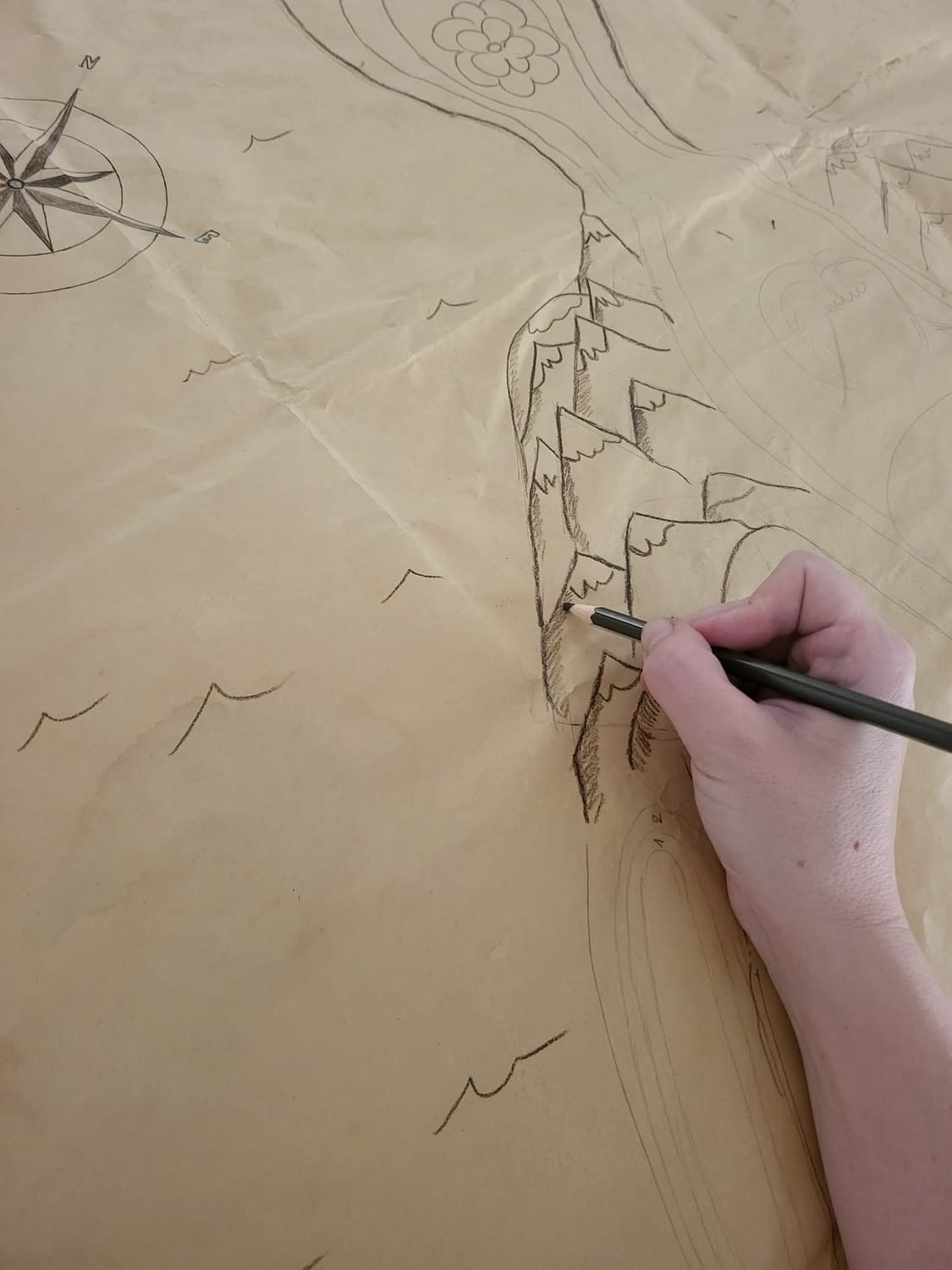
4.Creative Exercise : My Emotional Map
Duo Parent and child
Create Your Own Emotion Treasure Map
Materials
Paper, option 1 : a large roll, option 2: A4 or notebook
Your favorite creative material : Markers, crayons, paint, aquarelle, magazine
Glue, Cisor
Music
Old and Comfortable clothes
Step 1 – Trace Your Body
On a big piece of paper (body size) Child lie down on the paper while parent traces the body outline. Then switch. Your body shape is the island, the territory to explore.
Or in your notebook
trace only your hands or feet, this, will be the shape of your island
Step 2 – Transform Emotions into Landscapes
Invite everyone to use their imagination and ask themselves:
If this emotion were a landscape, what would it look like? Where do I feel it in my body?
Example : anger. Could it be a fiery volcano, a rocky mountain, a thunderstorm, or something completely different?
Then explore other emotions such as joy, excitement, love, sadness, fear, frustration, or calm. Each emotion can become its own unique place, filled with colors, textures, and symbols that feel meaningful to you.
There are no right or wrong answers. Encourage children—and adults—to invent their own symbols and trust their imagination. Add winding paths, rivers, bridges, caves, trees, animals, hidden treasures, or anything else that belongs in their emotional world. The more details they include, the richer and more personal their emotional map will become.
Step 3 – Hide Your Treasure
Every explorer searches for treasure.
Ask:
What is your greatest strength?
What helps you when life becomes difficult?
Where would you hide this treasure on your map?
Draw a treasure chest.
Inside write:
kindness
imagination
courage
humour
patience
creativity
Step 4 – Draw the Journey
Create paths connecting different places.
Questions:
Which path leads from fear to courage?
How do you travel from sadness to joy?
Is there a bridge?
A tunnel?
A rainbow?
A magical boat?
This helps children visualize emotional regulation as a journey rather than a destination.
When everyone has finished:
Invite each person to become the guide of their own map. Share your thoughts and symbols
Questions:
What place do you love the most?
Which place feels difficult?
What surprised you?
If someone visited your map, what would you want them to understand?
There are no right or wrong answers.
Listening is more important than interpreting.
5. Why This Activity Works
Creating an Emotion Map is about much more than drawing—it is a gentle way to connect with ourselves and with one another. Creative expression engages both the imagination and our emotional awareness, allowing feelings to emerge naturally through colors, symbols, and landscapes instead of relying solely on words. This process can be deeply calming, helping to reduce stress and quiet the mind while giving emotions a safe place to exist.
As we transform our inner experiences into images, thoughts and feelings that once seemed confusing begin to take shape. We can literally "see" our emotional world, making it easier to understand, accept, and talk about. For children, this often feels less intimidating than answering direct questions about their emotions. For parents, it opens the door to meaningful conversations based on curiosity rather than correction or advice.
Most importantly, this activity creates a safe, pressure-free space where every emotion is welcome. There is no right or wrong way to draw an emotional landscape, and no expectation to produce a beautiful piece of art. The true purpose is not artistic perfection—it is self-discovery, emotional understanding, and the opportunity to strengthen family connections through creativity and play.
Conclusion: Your Journey Begins Here
Every explorer knows that the greatest discoveries are not always found on distant shores—they are often hidden within. As you created your Emotion Map, you may have uncovered familiar places, surprising landscapes, or even hidden treasures you didn't know were there. Perhaps you crossed a storm before reaching a sunny meadow, climbed a mountain of courage, or found a quiet place where you could simply rest.
Remember that your emotional landscape is always changing. Just as nature transforms with the seasons, our inner world evolves as we grow, learn, and experience life. There is no final destination, only an ongoing journey of curiosity, self-awareness, and compassion.
Whether you completed this activity on your own or shared it with your family, I hope it inspired meaningful conversations and reminded you that every emotion has a purpose. By listening to what our bodies, symbols, and imagination have to tell us, we become kinder explorers of ourselves and of those we love.
Now I'd love to hear from you.
How was your journey?
What landscapes appeared on your map? Which symbols surprised you the most? Did you discover a hidden treasure, a forgotten path, or a place you would like to explore further?
Feel free to share your experience in the comments. Your story may inspire another family to begin their own adventure toward emotional intelligence—one symbol, one drawing, and one conversation at a time.
Read my next article : Build a strong mindset https://www.atelier-art-therapy.com/build-strong-mindset