
How the Violin Can Help You Find Calm and Joy
Introduction
1. Why Meditation + Violin Music Works So Well
2. How to Set the Mood
3. Exercise 1: Return to Calm
4. Exercise 2: Wake Up the Body
Bringing It Together
Introduction
It's 4pm, that fragile hour when patience runs thin and everyone in the house seems to need something at once. Instead of reaching for a screen, imagine reaching for a violin melody instead — and a pencil.
That's the idea behind this simple practice: pairing guided meditation with live, sustained music to help both parents and children find their way back to calm, one note at a time. The violin is a particularly gentle guide here. Its long, breathing tone doesn't rush or interrupt — it invites you to slow down, to notice, to simply listen. And when children (and let's be honest, most adults too) are given a pencil and permission to draw without trying to make something "good," something quietly beautiful happens: emotions that were hard to name suddenly have a color, a shape, a line.
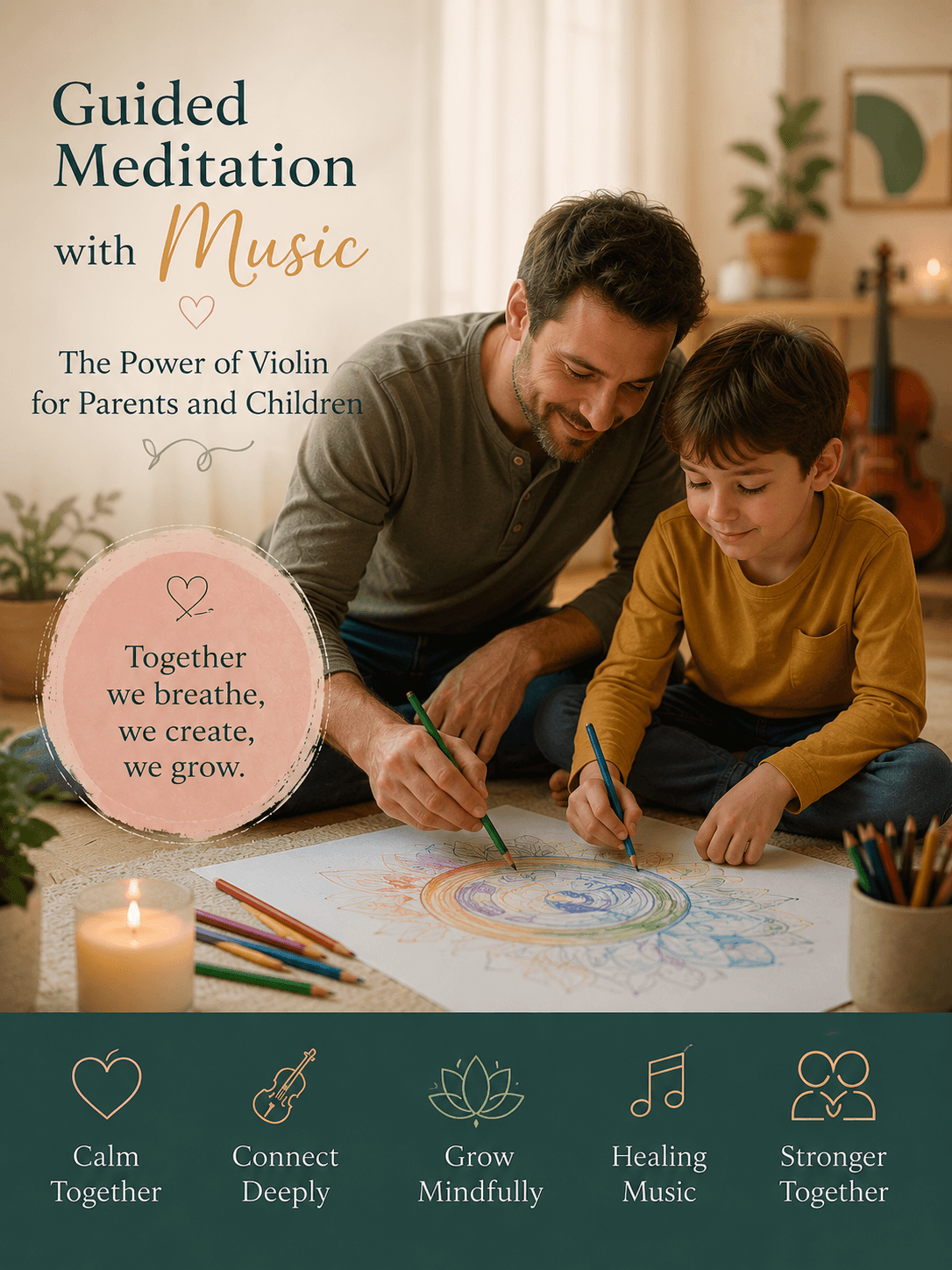
In this article, you'll find two short guided exercises to try with your child — no musical training required, no right or wrong way to do it. The first invites stillness and helps release big emotions through slow, flowing lines. The second flips the mood entirely, using a lively, syncopated piece to shake off stress and reconnect with joy through movement and color.
Grab two pencils, find a quiet corner, and let's begin.
1. Why Meditation + Violin Music Works So Well
A safe space for children's emotions
For children, this simple pairing of music and mindfulness does more than pass the time — it builds emotional vocabulary. When kids draw while listening, they start to notice and name what they feel instead of just reacting to it. It also helps regulate big emotions before they turn into meltdowns, sharpens focus in a way that feels playful rather than forced, and turns mindfulness into something closer to a game than a chore.
A shared pause for parents
Parents need this just as much as their children do. A few minutes of guided listening offers a genuine pause in an otherwise nonstop day — one where nobody has to fix, explain, or manage anything. It also quietly models self-regulation: when children see a parent breathing slowly and letting a pencil wander, they learn what calm actually looks like. And because the exercise doesn't require talking about feelings directly, it creates real connection without the pressure of a conversation.
Why the violin, specifically
Not every instrument works the same way for this. The violin's sustained, almost vocal tone mimics the human voice and breath, which makes it unusually easy to sync your own breathing to the music. Unlike songs with lyrics, purely instrumental violin leaves space for the imagination — there's no "correct" story being told, so each person's drawing becomes entirely their own.
What the research suggests
This isn't just a nice idea — it's backed by evidence. Slow, sustained music has been shown to lower cortisol levels and improve heart rate variability, both markers of a calmer nervous system. In other words, the effect you feel during these exercises isn't imagined; your body is measurably settling down.
2. How to Set the Mood
Find a quiet corner
Before you begin, choose a calm spot in your home — away from screens, or the ping of notifications. It doesn't need to be a dedicated meditation room; a corner of the living room floor or a cozy spot on the bed works just as well. Dim the lights if you can. The goal isn't a perfect setup, just enough stillness for the music to be heard.
Prepare your materials in advance
Have paper/ notebook and drawing tools within reach before you press play — crayons, markers, pencils, whatever you already have at home. Simplicity is the point here, not a fully stocked art cabinet.
Let go of expectations
This is not an art class, and there is no finished piece to be proud of at the end. Remind your child (and yourself) that the drawing doesn't need to look like anything — it's simply where the music and the breath happen to land. The moment someone starts worrying about "doing it right," the calming effect disappears.
Do it together, side by side
The exercise works best when parent and child draw at the same time, side by side, both fully present. You're not there to guide your child's hand or correct their lines — you're there to share the experience. Sitting down and picking up your own pencil sends a quiet message: this matters enough for me to do it too.
3. Exercise 1: Return to Calm
Choosing Your Order
Here are two guided meditation and drawing exercises — one calm, one energetic. There's no fixed rule for which one comes first; it really depends on when you're practicing and what your family needs in that moment.
. If you're practicing in the morning, start with the first exercise (calm) to ease into the day gently, then move into the second (energetic) — a wonderful way to wake up the body and bring positive energy into the hours ahead.
. If you're practicing in the evening, flip the order: begin with the energetic exercise first, letting the day's emotions move through and out, then close with the calm exercise to help everyone settle down and prepare for a peaceful night.
Either way, the goal is the same — two moods, two colors, one shared moment of connection.
The piece: a soft, sustained violin piece — Glwysen
The goal: to slow down, breathe, and let whatever emotion is sitting quietly inside come to the surface, without judging it.
Close your eyes gently
There's nothing to look at right now — only something to listen to.
Breathe like a balloon
As the violin begins, breathe as if your belly were a balloon: slowly filling up as you breathe in, slowly deflating as you breathe out. Let the music set the pace — there's no need to rush.
Let each note become a color
Imagine that every note floating through the air is a color coming to visit you. You don't need to choose it on purpose — just notice which color shows up in your mind as you listen.
Draw without thinking
Open your eyes, pick up a pencil, and let it move to the rhythm of the violin — without planning, without deciding what it should look like. There is no beautiful drawing and no bad one here; your lines are simply dancing along with the music.
Look, and ask
When the piece ends, look together at what you've drawn. What do you see? And gently — which emotion came to visit you today?
Suitable for all ages — this is a wonderful first exercise if you're introducing guided meditation to your child for the very first time.
Parent tip: invite your child to name their emotion out loud if they feel like it, but never push for an answer. Often, the drawing has already said enough.
4. Exercise 2: Wake Up the Body
The piece: an upbeat, syncopated piece — Paragon Rag
The goal: to shift from stillness into playful energy — a joyful contrast to the first exercise, showing that meditation isn't only about sitting quietly, it can also mean moving with music.
Wake up your hands
Sit up tall, open your eyes, and give your fingers a little wiggle to warm them up. This exercise is about energy, so let your body know it's time to move.
Notice the bounce
Listen to the first few notes of the piece. Feel how fast and bouncy they are compared to the calm violin from before — the rhythm jumps and skips, and your body can feel it too.
Choose your energetic colors
Pick two or three colors that feel lively to you — the ones that seem to jump off the page rather than sit still. There's no wrong choice, just whatever feels bright and alive in the moment.
Let your whole arm dance
This time, don't just move your wrist — let your whole arm swing. Big loops, zigzags, dots, little bounces, following every jump and syncopation in the music. When the music speeds up, draw faster. When it pauses, let your pencil pause too.
Look, and ask
When the piece ends, look at your page together. Is it busier, brighter, more chaotic than the first drawing? Ask each other: how does your body feel right now? Where do you feel that energy — in your hands, your chest, your feet?
Suitable for all ages — especially wonderful for children who find sitting still difficult, since it gives them full permission to move while still staying mindful.
Family tip: once both drawings are finished, place them side by side and talk about how calm and joy can look — and feel — completely different from one another.
Bringing It Together
Two moods, both valid
Looking at the two drawings side by side often says more than words could. One calm, one energetic — both true reflections of what was felt in that moment. There's no better or worse feeling here, just two very different, equally valuable ways of being present with your child.
Build a simple family ritual
You don't need a strict schedule to make this meaningful. Try setting aside one calm piece and one joyful piece, once or twice a week, whenever it fits naturally into your rhythm — a quiet Sunday morning, or a way to unwind after school. Over time, this small ritual becomes something your child looks forward to, not another task on the calendar.
Keep the drawings as a quiet record
Consider saving the drawings in a small folder, or better yet, an art journal dedicated just to this practice. Flipping back through them months later becomes a gentle, colorful timeline of moods and growth — a reminder of how far you and your child have come, one note and one line at a time.
If you'd like to keep exploring how creativity can support emotional wellbeing, take a look at The Map of Emotions: Journey Toward Emotional Intelligence and Shaping Peace: Why Sculpting Is a Powerful Tool for Anxiety Relief.